Mission & Overview
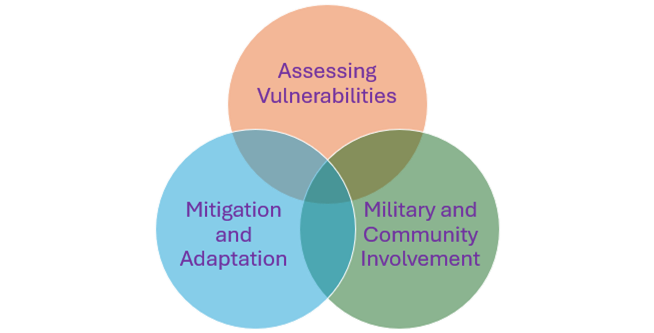
The NEFRC’s Resiliency Program works to build resilience to climate-related hazards for the communities of Northeast Florida. The three circles in the diagram below represent the three main spheres of action of the program, with many initiatives and projects functioning in the overlapping areas. The Resiliency Program provides services to local governments and other partners, including regional coordination to address resiliency issues, technical assistance on vulnerability assessments and adaptation plans, partnership on projects to address resiliency at multiple scales, educational presentations and community events, and much more.
Resilient First Coast
Northeast Florida has a Regional Resiliency Collaborative called Resilient First Coast. The purpose of the Collaborative is to bring together people from diverse backgrounds to tackle regional challenges involving resiliency to the effects of climate change, including sea level rise, flooding, and other hazards. This Collaborative is made up of many partners from multiple sectors, including local government, business, non-profit organizations, academic institutions, state and local agencies, utilities, and the military. Please visit the Resilient First Coast website to join the distribution list or to find out the most up-to-date information, including meeting dates and summaries.
Current Initiatives & Projects
Regional Resilience Action Plan
Developed by the NEFRC and the Resilient First Coast with funding from the Resilient Florida Program, this five-year action plan outlines a unified approach to increasing resilience across Northeast Florida. The Plan defines shared goals, identifies local and regional vulnerabilities, and provides actionable strategies for governments, utilities, nonprofits, and businesses to strengthen resilience together—far beyond what any single entity could accomplish alone. The Plan is currently in Phase III, which focuses on identifying metrics to measure success, funding sources most appropriate for each action, and additional resources to supplement implementation, with an expected completion date of June 2026.
Regional Vulnerability Assessment Analysis
The NEFRC is currently conducting a regionwide analysis of all the local vulnerability assessments that have been completed to date. The analysis consists of identifying regionally significant assets that are at risk of flooding, any regional trends that can be found in the data, and any discrepancies among the various datasets. This information will be housed on the Resilient First Coast Vulnerability Assessment Portal and used in regional resilience planning. This work funded by the Resilient Florida Program is expected to be completed by June 2026.
Adaptation Planning Guide
Developed by the NEFRC in partnership with a working group of the Resilient First Coast Collaborative, this guide will provide a foundation for Northeast Florida local governments to develop adaptation plans for their communities. This work builds upon the Florida Adaptation Planning Guidebook while being tailored for the region and is funded by the Resilient Florida Program. It is expected to be completed in June 2026.
Northeast Florida Military Installation Readiness Review
This project funded by the Office of Local Defense Community Cooperation identifies vulnerabilities that can impact military installation mission assurance by assessing risks outside the fenceline, and it establishes a plan for mitigating these risks and building community resilience. The project relies heavily on a collaborative process utilizing input from a Steering Committee and a Technical Advisory Committee and is expected to be completed by September 2026.
Pinecastle and Bugg Spring Military Installation Readiness Review
The NEFRC is partnering with the East Central Florida Regional Planning Council to assess factors that may affect installation operations at both the Pinecastle Range Complex and the Underwater Sound Reference Division (USRD) Leesburg Facility (LEFAC) at Bugg Spring. Additional information on this project can be found in a here.
Local Government Assistance
The NEFRC assists local governments with obtaining and completing vulnerability assessments, which identify and analyze the potential impacts of current and future flood risks on the natural, built, and social environments. These assessments provide a technical foundation to support adaptation planning, risk reduction strategies, and future funding opportunities, for which the NEFRC also provides assistance. The NEFRC is currently assisting with projects underway in multiple jurisdictions within the region.
Multiregional Planning and Mitigation Assessment
This project funded by Florida Commerce is a collaboration among 6 different regional planning councils to conduct a large-scale vulnerability assessment for extreme rainfall induced flooding for both coastal and inland areas and develop corresponding mitigation plans and projects, along with a best practices website. The project is currently in the phase of planning for regional and statewide training sessions, with an expected completion date of September 2026.
Community Capacity Building and Planning in Vulnerable Communities of the South Atlantic Salt Marsh Initiative
This project funded by the National Fish and Wildlife Foundation is a partnership among 4 states (FL, GA, SC, and NC) to develop a suite of 20-25 nature-based solution project sites in vulnerable communities based on data analysis and community input, with an eventual goal of moving the projects forward through design and implementation stages. The overall purpose is to promote saltmarsh conservation in the Southeast United States. The project is underway, with Community Conversations to be held soon, and is expected to be completed in September 2026.
Assessing Infrastructure Vulnerability and Aquatic Connectivity Benefiting Resilience of Florida's First Coast
The NEFRC was awarded a grant from the National Fish and Wildlife Foundation in January 2026 to facilitate assessments of road-stream crossings to determine if there are barriers to aquatic connectivity or risks to nearby infrastructure and to prioritize sites for future barrier removal projects using nature-based solutions. Key project partners include Jacksonville University, University of North Florida, Southeast Aquatic Resources Partnership, Florida Fish and Wildlife Conservation Commission, Pew Charitable Trust, and North Florida Land Trust.
Resilient Infrastructure Benefit Cost Analysis Tool
The NEFRC is partnering with the South Florida Regional Planning Council and other RPCs to expand a Resilient Infrastructure Cost-Benefit Analysis Tool on a statewide level. The tool was originally created for the South Florida region, but it is now being tailored to each region in Florida using input from various stakeholders. The tool refinement is expected to be completed in June 2026, and the NEFRC will provide training and technical assistance to end users.
Community Rating System User Group
This is a subject specific forum for communities participating in the FEMA Community Rating System. The group convenes quarterly to share information, local updates, and best practices related to floodplain management and CRS participation.
NEFRC Resiliency Tools and Resources
- Regional Resilience Exposure Tool (R2ET)
- Regional Resilience Priorities Analysis Story Map
- Supplemental Manual for Vulnerability Assessments in Northeast Florida
- Vulnerability Assessment Portal
Fara Ilami
Regional Resiliency Manager
 Email: filami@nefrc.org
 Phone: (904) 534-3650
Andrew Prokopiak
Senior Resiliency Planner
Email: aprokopiak@nefrc.org
Phone: (904) 749-4446
Apurva Jhamb
Senior Resiliency Planner
Email: ajhamb@nefrc.org
Phone: (904) 846-6594
Robert Jordan
Senior GIS Planner
Email: rjordan@nefrc.org

 Subscribe to Our Mailing List